Thursday, November 30, 2023

New Rite of Extreme Unction

 Not just for those who are at the point of death. It is meant for anyone who is suffering a serious illness: physical, emotional, mental or spiritual. The Sacrament may be received at any time during a person’s illness, especially before surgery or treatment. Sacraments are for the living.


How is the Sacrament celebrated?

Anointing of the Sick is a Sacrament of the Church. Therefore it is preferable, as far as possible, to celebrate the rite when others can be present.

The Sacrament is administered by a priest and follows this structure:

a) The rite begins with the Sign of the Cross with blessed water which reminds us of our baptismal promise to die with Christ so that we might rise to new life with him.

b) The readings from Scripture are adapted to the condition of the sick person.  

c) The Sacrament of Penance (Confession) may be celebrated within the Sacrament of Anointing of the Sick.

d) The priest places his hands on the head of the one to be anointed, and anoints the forehead and hands of the sick person with the Oil which has been blessed by the Bishop during Holy Week.

e) Holy Communion may be received at this time.

f) The priest then blesses the sick person and all present.

What happens if death is imminent or has occurred?

If death is imminent and the patient has not already been anointed, the priest should be called to give the Sacrament of the Sick for the spiritual healing of the patient and the comfort of the relatives. If the patient is conscious the priest will offer the last Holy Communion (Viaticum) that is given as food for the final journey.

Depending on the circumstances, the priest will pray the prayers of Commendation of the Dying.

If death has taken place, the Prayers for the Dead are prayed and the body is sprinkled with Holy Water recalling the promise of New Lifehe deceased received in Baptism.


Wednesday, November 29, 2023

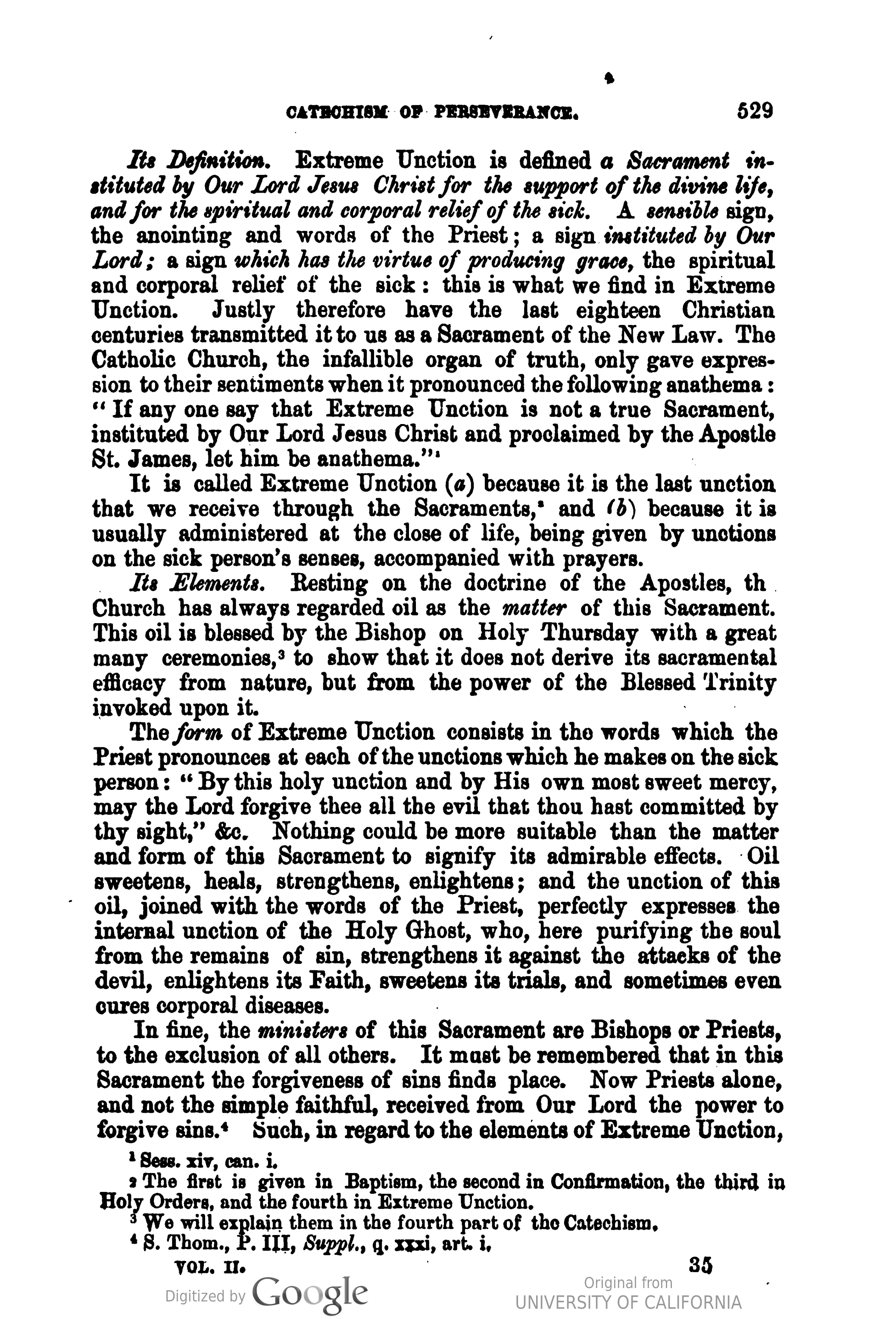
Extreme Unction. Roman Catechism

 THE SACRAMENT OF EXTREME UNCTION

Importance Of Instruction On Extreme Unction

In all thy works, the Scriptures teach, remember thy last end, and thou shalt never sin, words which convey to the pastor a silent admonition to omit no opportunity of exhorting the faithful to constant meditation on death. The Sacrament of Extreme Unction, because inseparably associated with recollection of the day of death, should, it is obvious, form a subject of frequent instruction, not only because it is right to explain the mysteries of salvation, but also because death, the inevitable doom of all men, when recalled to the minds of the faithful, represses depraved passion. Thus shall they be less disturbed by the approach of death, and will pour forth their gratitude in endless praises to God, who has not only opened to us the way to true life in the Sacrament of Baptism, but has also instituted that of Extreme Unction, to afford us, when departing this mortal life, an easier way to heaven.

Names of this Sacrament

In explaining what is more necessary on this subject we shall follow almost the same order observed in the exposition of the other Sacraments. Hence we shall first show that this Sacrament is called Extreme Unction, because among all the unctions prescribed by our Lord to His Church, this is the last to be administered.

For this reason it was also called by our predecessors in the faith, the Sacrament of the anointing of the sick, and also the Sacrament of the dying, names which easily turn the minds of the faithful to the remembrance of that last hour.

Extreme Unction Is a True Sacrament

That Extreme Unction is strictly speaking a Sacrament, is first to be explained; and this the words of St. James the Apostle, promulgating the law of this Sacrament, clearly establish. Is any man, he says, sick amongst you ? Let him bring in the priests of the church, and let them pray over him, anointing him with oil in the name of the


Lord: and the prayer of faith shall save the sick man; and the Lord shall raise him up; and if he be in sins, they shall be forgiven him. When the Apostle says that sins are forgiven, he ascribes to Extreme Unction the nature and efficacy of a Sacrament.

That such has been at all times the doctrine of the Catholic Church on Extreme Unction, many Councils testify, and the Council of Trent denounces anathema against all who presume to teach or think otherwise. Innocent I also recommends this Sacrament with great earnestness to the attention of the faithful.

Extreme Unction Is But One Sacrament

Pastors, therefore, should teach that Extreme Unction is a true Sacrament, and that, although administered with many anointings, each given with a peculiar prayer, and under a peculiar form, it constitutes not many, but one Sacrament. It is one, however, not in the sense that it is composed of inseparable parts, but because each of the parts contributes to its perfection, as is the case with every object composed of many parts. As a house which consists of a great variety of parts derives its perfection from unity of plan, so is this Sacrament, although composed of many and different things and words, but one sign, and it effects only that one thing of which it is the sign.

Essential Parts of Extreme Unction

Pastors should also teach what are the component parts of this Sacrament, its matter and form. These St. James does not omit, and each is replete with its own peculiar mysteries.

The Matter Of Extreme Unction

Its element, then, or matter, as defined by Councils, particularly by the Council of Trent, consists of oil consecrated by the Bishop. Not any kind of oil extracted from fatty or greasy substances, but olive oil alone (can be the matter of this Sacrament).

Thus its matter is most significant of what is inwardly effected in the soul by the Sacrament. Oil is very efficacious in soothing bodily pain, and the power of this Sacrament lessens the pain and anguish of the soul. Oil also restores health, brings joy, feeds light, and is very efficacious in refreshing bodily fatigue. All these effects signify what the divine power accomplishes in the sick man through the administration of this Sacrament. So much will suffice in explanation of the matter.

The Form Of Extreme Unction

The form of the Sacrament is the word and solemn prayer which the priest uses at each anointing: By this Holy Unction may God pardon thee whatever sins thou hast committed by the evil use of sight, smell or touch.

That this is the true form of this Sacrament we learn from these words of St. James: Let them pray over him . . . and the prayer of faith shall save the sick man. Hence we can see that the form is to be applied by way of prayer. The Apostle does not say of what particular words that prayer is to consist; but this form has been handed down to us by the faithful tradition of the Fathers, so that all the Churches retain the form observed by the Church of Rome, the mother and mistress of all Churches. Some, it is true, alter a few words, as when for God pardon thee, they say (God) remit, or (God) spare, and sometimes, May (God) remedy all the evil thou hast committed. But as there is no change of meaning, it is clear that all religiously observe the same form.

It should not excite surprise that, while the form of each of the other Sacraments either absolutely signifies what it expresses, such as I baptise thee, or I Sign thee with the sign of the cross, or is pronounced, as it were, by way of command, as in administering Holy Orders, Receive power, the form of Extreme Unction alone is expressed by way of prayer. Wisely has it been so appointed. For since this Sacrament is administered not only for the spiritual grace which it bestows, but also for the recovery of health, which, however, is not always obtained, therefore use a deprecative form, in order to implore of God's mercy what the virtue of the Sacrament does not always and uniformly effect.

The Ceremonies Of Extreme Unction

In the administration of this Sacrament special rites are also used, consisting principally of prayers offered by the priest for the recovery of the sick person. There is no Sacrament, the administration of which is accompanied with more numerous prayers; and with good reason, for at that moment more than ever the faithful require the assistance of pious prayers. All who may be present, and especially the pastor, should pour out their fervent aspirations to God, and earnestly commend to His mercy the life and salvation of the sufferer.

Institution of Extreme Unction

Having thus proved that Extreme Unction is truly and properly to be numbered among the Sacraments, we rightly infer that it owes its institution to Christ our Lord. It was subsequently made known and promulgated to the faithful by the Apostle St. James.

Our Saviour Himself, however, seems to have given some indication of it, when He sent His disciples two and two before Him; for the Evangelist informs us that going forth, they preached that all should do penance; and they cast out many devils, and anointed with oil many who were sick, and healed them.

This anointing cannot be supposed to have been invented by the Apostles, but was commanded by our Lord. Nor did its power arise from any natural virtue. Its efficacy, we must believe, was mystical, having been instituted to heal the maladies of the soul, rather than to cure the diseases of the body. This is the doctrine taught by St. Denis, St. Ambrose, St. Chrysostom and St. Gregory the Great; so that it cannot be at all doubted that Extreme Unction is to be recognised and venerated as one of the seven Sacraments of the Catholic Church.

The Subject of Extreme Unction

But although instituted for the use of all, Extreme Unction is not lo be administered indiscriminately to all.

The Subject Must Be In Danger Of Death

In the first place, it is not to be administered to persons in sound health, according to these words of St. James: Is anyone sick amongst you? This is also proved by the fact that Extreme Unction was instituted as a remedy not only for the diseases of the soul, but also for those of the body. Now only the sick need a remedy, and therefore this Sacrament is to be administered to those only whose malady is such as to excite apprehensions of approaching death.

It is, however, a very grievous sin to defer the Holy Unction until, all hope of recovery being lost, life begins to ebb, and the sick person is fast verging into a state of insensibility. It is obvious that if the Sacrament is administered while consciousness and reason are yet unimpaired, and the mind is capable of eliciting acts of faith and of directing the will to sentiments of piety, a more abundant participation of its graces must be received. Though this heavenly medicine is in itself always salutary, pastors should be careful to apply it when its efficacy can be aided by the piety and devotion of the sick person.

The Danger Must Arise From Sickness

Extreme Unction, then, can be administered to no one who is not dangerously sick; not even to those who are in danger of death, as when they undertake a perilous voyage, or enter into battle with the sure prospect of death, or have been condemned to death and are on the way to execution.

The Person Anointed Must Have Attained The Use Of Reason

Furthermore, all those who have not the use of reason are not fit subjects for this Sacrament; and likewise children who, having committed no sins, do not need the Sacrament as a remedy against the remains of sin. The same is true of idiots and insane persons, unless they give indications in their lucid intervals of a disposition to piety, and express a desire to be anointed. To persons who from their birth never enjoyed the use of reason this Sacrament is not to be administered; but if a sick person, while in the possession of his faculties, expresses a wish to receive Extreme Unction and afterwards becomes delirious he is to be anointed.

Administration of Extreme Unction

The Sacred Unction is to be applied not to the entire body, but to the organs of sense only, -- to the eyes, on account of sight; to the ears, on account of hearing; to the nostrils, on account of smell; to the mouth, on account of taste and speech; to the hands, on account of touch. The sense of touch, it is true, is diffused throughout the entire body, yet it is more developed in the hands.

This manner of administering Extreme Unction is observed throughout the universal Church, and is in keeping with the medicinal nature of the Sacrament. As in corporal disease, although the malady affects the entire body, yet the cure is applied to that part only which is the seat and origin of the disease; so likewise this Sacrament is applied not to the entire body, but to those members in which the power of sensation is most conspicuous, and also to the loins, which are, as it were, the seat of concupiscence, and to the feet, by which we move from one place to another.

Here it is to be observed that, during the same illness, and while the danger of dying continues the same, the sick person is to be anointed but once. Should he, however, recover after he has been anointed, he may receive the aid of this Sacrament as often as he shall have relapsed into the same danger of death. This Sacrament, therefore, is evidently to be numbered among those which may be repeated.

Dispositions for the Reception of Extreme Unction


As all care should be taken that nothing impede the. grace of the Sacrament, and as nothing is more opposed to it than the consciousness of mortal guilt, the constant practice of the Catholic Church must be observed of administering the Sacrament of Penance and the Eucharist before Extreme Unction.

And next, let parish priests strive to persuade the sick person to receive this Sacrament from the priest with the same faith with which those of old who were to be healed by the Apostles used to present themselves. But the salvation of his soul is to be the first object of the sick man's wishes, and after that the health of the body, with this qualification, if it be for the good of his soul.

Nor should the faithful doubt that those holy and solemn prayers which are used by the priest, not in his own person, but in that of the Church and of our Lord Jesus Christ, are heard by God; and they are most particularly to be exhorted on this one point, to take care that the Sacrament of this most salutary oil be administered to them holily and religiously, when the sharper conflict seems at hand, and the energies of the mind as well as of the body appear to be failing.

The Minister of Extreme Unction

Who the minister of Extreme Unction is we learn from the same Apostle that promulgated the law of the Lord; for he says: Let him bring in the priests (presbyters). By which name, as the Council of Trent has well explained, he does not mean persons advanced in years, or of chief authority among the people, but priests who have been duly ordained by Bishops with the imposition of hands.

To the priest, therefore, has been committed the administration of this Sacrament; not, however, to every priest, as holy Church has decreed, but to the proper pastor who has jurisdiction, or to another authorised by him to discharge this office.

In this, however, as also in the administration of the other Sacraments, it is to be most distinctly remembered that the priest is the representative of Christ our Lord, and of His spouse, holy Church.

The Effects of Extreme Unction

The advantages we receive from this Sacrament are also to be accurately explained, so that if nothing else can allure the faithful to its reception, they may be induced at least by its utility; for we are naturally disposed to measure almost all things by our interests.

Pastors, therefore, should teach that by this Sacrament is imparted grace that remits sins, and especially lighter, or as they are commonly called, venial sins; for mortal sins are removed by the Sacrament of Penance. Extreme Unction was not instituted primarily for the remission of grave offences; only Baptism and Penance accomplish this directly.

Another advantage of the Sacred Unction is that it liberates the soul from the languor and infirmity which it contracted from sins, and from all the other remains of sin. The time most opportune for this cure is when we are afflicted with severe illness and danger to life impends, for it has been implanted in man by nature to dread no human visitation so much as death. This dread is greatly augmented by the recollection of our past sins, especially if our conscience accuses us of grave offences; for it is written: They shall come with fear at the thought of their sins, and their iniquities shall stand against them to convict them. Another source of vehement anguish is the anxious thought that we must soon afterwards stand before the judgment seat of God, who will pass on us a sentence of strictest justice according to our deserts. It often happens that, struck with this terror, the faithful feel themselves deeply agitated; and nothing conduces more to a tranquil death than to banish sadness, await with a joyous mind the coming of our Lord, and be ready willingly to surrender the deposit entrusted whenever it shall be His will to demand it back. To free the minds of the faithful from this solicitude, and fill the soul with pious and holy joy is, then, an effect of the Sacrament of Extreme Unction.

From it, moreover, we derive another advantage, which may justly be deemed the greatest of all. For although the enemy of the human race never ceases, while we live, to meditate our ruin and destruction, yet at no time does he more violently use every effort utterly to destroy us, and, if possible, deprive us of all hope of the divine mercy, than when he sees the last day of life approach. Therefore arms and strength are supplied to the faithful in this Sacrament to enable them to break the violence and impetuosity of the adversary, and to fight bravely against him; for the soul of the sick is relieved and encouraged by the hope of the divine goodness, strengthened by which it bears more lightly ail the burdens of sickness, and eludes with greater ease the artifice and cunning of the devil who lies in wait for it.

Finally, the recovery of health, if indeed advantageous, is another effect of this Sacrament. And if in our days the sick obtain this effect less frequently, this is to be attributed, not to any defect of the Sacrament, but rather to the weaker faith of a great part of those who are anointed with the sacred oil, or by whom it is administered; for the Evangelist bears witness that the Lord wrought not many miracles among His own, because of their unbelief.

It may also be truly said at the Christian religion, since it has struck its roots more deeply in the minds of men, stands now less in need of the aids of such miracles than it did formerly, at the commencement of the rising Church. Nevertheless, faith should be strongly excited in this respect, and whatever it may please God in His wisdom to do with regard to the health of the body, the faithful ought to rely on a sure hope of attaining, by virtue of this sacred oil, health of the soul, and of experiencing, should the hour of their departure from life be at hand, the fruit of that glorious assurance: Blessed are the dead who die in the Lord.

Admonition

We have thus explained briefly the Sacrament of Extreme Unction. But if these points are developed by the pastor at greater length and with the care the subject demands, it is not to be doubted that the faithful will derive very great fruit of piety from his instruction.

Monday, November 27, 2023

A short Catechism on the new theology

 A SHORT CATECHISM ON THE NEW THEOLOGY

BY JOHN VENNARI

The New Theology is a false "religious" system that became popular among Catholics in Europe from the 1920s onward. Because it was recognized as resurgent modernism, it was kept under a lid by the Vatican and was condemned by Pope Pius XII in Humani Generis. Its primary founders were Maurice Blondel, Father Henri de Lubac and Hans Urs von Balthasar. It enjoys an undeserved popularity today.


What is the main contention of the partisans of the New Theology?


 In 1950, The Thomist published an article by Father David Greenstock that warned against the New Theology. He explained that "The main contention of the partisans of this new movement is that theology, to remain alive, must move with the times" and that "traditional theology is out of touch with reality." Their hallmark has always been scorn for the Magisterium.

How do they scorn the Magisterium?

 The Popes have consistently taught that the philosophy and theology of St. Thomas Aquinas (Scholasticism) is the irreplaceable basis for Catholic teaching. In his Encyclical Pascendi, Pope St. Pius X said that Scholasticism was the remedy for modernism. He further warned, "We admonish professors to bear well in mind that they cannot set aside St. Thomas especially in metaphysical questions, without grave disadvantage."  Yet the founders of the New Theology were unanimously resolved that the Aristotelian system on which Thomism is based must be abandoned in favor of new philosophical systems.

Why is this fatally flawed?

 Father Greenstock shows that modern philosophies cannot be "synthesized" into Catholic theology because "most people outside the Church suffer from an almost complete incapacity for logical thought. Their basis for argument is sentiment rather than reason. ... This incapacity (for logical thought) is a direct result of these modern philosophies which we are now asked to adopt and to baptize — an impossible task."

Where is the difficulty?

 Father Greenstock explained, "we are asked to substitute for the clear metaphysical notions of Aquinas the fluid concepts of modern philosophies, and it is very difficult indeed for us to see how that can be done without harm to the unchangeable doctrines of the Faith."


Can any examples be given of how the rejection of Thomist philosophy threatens Catholic theology?


 One example among many is that it can destroy the Catholic teaching on the Real Presence in the Eucharist as defined by the Council of Trent.

How?

 Our definition of transubstantiation reads that the accidents of the consecrated bread stay the same — it still looks, smells, feels and tastes like bread. But the substance is no longer bread, but the Body, Blood, Soul and Divinity of Jesus Christ. Substance and accidents are foundational terms of Thomistic/Aristotelian metaphysics. Our dogmatic definition of the Eucharist is based on these terms. If these metaphysical terms are not considered stable, and are now subject to new definitions and new meanings, then the very foundation of our doctrine on the Eucharist is shaken, and the definition of the Eucharist will change. Garrigou-Lagrange pointed out that the rejection of Thomistic philosophy places many doctrines in jeopardy such as original sin, sanctifying grace, the finality of the particular judgment and even truth itself.

Has this rejection of the Council of Trent's teaching on the Eucharist actually happened?
 

In 1946, Father Garrigou-Lagrange quoted one advocate of the New Theology who said that transubstantiation was conceived of and defined by the scholastics (Thomists) and that "their doctrine is inadmissable."

Who was Maurice Blondel?

 Maurice Blondel [1861-1949], a layman, ultimately formulated the philosophy on which the New Theology is based. In order to "win over modern men" who reject objectivism (the submission of the mind to objective reality) Blondel formulated a "subjectivist" philosophy, more in line with other modern philosophies.

How did he do this?

 By stating that religion is not something that goes from the head to the heart (objective reality) , but from heart to head (subjective). He said, "nothing can enter man which does not come from out of him and correspondence in some way to a need he has of expansion." Hence anything supernatural (sanctifying grace) that is in man ultimately comes from the nature of man himself.

What's wrong with that?

 St. Paul says "Faith comes by hearing" — that is, it comes from God presenting reality to man and then man accepting it. Also sanctifying grace (our created participation in the Divine Life of God) is not natural to us. It is a free gift that is above our nature (more on this later) Neither Faith, nor the supernatural life of grace is "inside man" already. Yet Blondel said "Nothing can enter man which does not come from out of him." Blondel's teaching, in fact, is an extension of the Modernist notion of "Divine Immanence" condemned by Pope St. Pius X. That's why many refer to Blondel as a "neo-modernist".

Was Blondel in good faith?

 The great Dominican, Father Garrigou-Lagrange believed that Blondel was not in good faith. Blondel manifested the standard trademarks of a modernist: 1) Blondel quoted texts of St. Thomas to make them mean the opposite of what they say; 2) he repeatedly met well- argued criticism from his adversaries with a mere categorical denial; 3) he continually claimed to be misunderstood; 4) he was always "explaining" how his thinking is really orthodox, so that to this day it is disputed what he is actually saying; 5) years later, he admitted to Fr. Henri de Lubac that he purposely disguised his true ideas in order to escape certain censure from Catholic authorities.

Who was Father Henri de Lubac?

 Father de Lubac [1896, 1991] was a Jesuit who saw in Blondel's teaching the basis of a New Theology. Blondel had rejected Thomistic philosophy, and de Lubac would incorporate this into a new system that would reject Thomistic theology.

Did the New Theology have any sympathizers in high place?

 Even though Pope Pius XII had warned against these new teachings, the Vatican Secretary of State, Msgr. Montini, gave encouragement to the New Theology. At the same time, Montini was also conducting back-door dealings with the Stalinists, again, contrary to the will of Pius XII.


Montini was elected Pope VI

What is the heart of de Lubac's New Theology?

 Building on Blondel's philosophy, de Lubac taught that the supernatural is a necessary perfection of nature, without which nature is frustrated in its essential aspirations. This means that the supernatural is needed to complete nature which remains incomplete without it. Hence, the supernatural is not a gratuitous gift but a part of nature owed to nature; in other words, the supernatural is not supernatural but natural, and lies within the bounds of nature.

Why is this wrong?

 The Catholic Church teaches that the whole supernatural order of grace is exactly that: gratuitous — a sheer gift of God. Nature may be capable or well-suited to supernature, but it in no way strictly requires grace which is of a different order, infinitely superior, and given by God, as God wills, in a manner essentially independent of the received nature. This New Theology leads to pantheism. In 1981, in his book Gethsemane, the lone voice of Cardinal Siri got right to the heart of de Lubac's confusion. He warned that if de Lubac's theology is taken to its logical conclusion, "it would mean that either Jesus Christ is not God, or that man is Divine" — again, modernism!

Was de Lubac in good faith?

 Father Garrigou-Lagrange exposed de Lubac's errors in his 1946 article "Where is the New Theology Leading Us?," pointing out that this new theology is just a re-hash of modernism. De Lubac simply responded with insults and mockery, accusing Garrigou-Lagrange of having "simplistic views on the absoluteness of truth." When Pope Pius XII condemned de Lubac's theology in Humani Generis,(#'s 29,30,32,34), de Lubac simply stated that this was "highly one-sided ... it doesn't concern me."
But wasn't de Lubac a great expert on the Fathers of the Church?


Writing in The Thomist (1950) Father David Greenstock warned that the only reason that the leaders of the New Theology overwhelm the reader with the Greek Fathers is in order to get around St. Thomas Aquinas, whom they actually disdain, no matter how much they pledge their devotion to him.

Anything else about de Lubac?

 Henri de Lubac was an avid defender of the evolutionist/pantheist Teilhard de Chardin. Teilhard also propagated great confusion regarding the natural and supernatural orders, claiming that nature evolves into supernature — again, modernism!

Can Teilhard be defended as orthodox?

 Not at all. How is it possible to defend a man who makes pantheistic statements such as, "Catholicism deceived me with its narrow definitions of the World ... The World around me becomes divine ..."

Did de Lubac have any regrets?

 At the end of his life, he started to wonder if perhaps he hadn't allowed himself to stray into forbidden doctrine. He wrote, "This period is as full of error as any ... maybe I should have concentrated more on essentials ... for the last seven or eight years I have been paralyzed by the fear of confronting head on, in concrete fashion, the essential problems in their scolding reality? Out of wisdom or weakness? Was I right or wrong?" By then, however, he had already done his damage. Today, his cult lives on.

Who Was Hans Urs von Balthasar?

 Father von Balthasar was a disciple of the New Theology whose books are extremely popular within "conservative" circles. In the 1930s, he developed a powerful aversion to the scholastic theology of St. Thomas. He then became greatly influenced by Karl Barth, the famous Protestant thinker. Von Balthasar made Christ, rather than the Catholic Church, the center of Christian unity — as if Christ could somehow be divorced from His one true Church — hence, paving the way for "Catholic" ecumenism. He favored and incorporated the philosophy of Hegel, which is the philosophy of "becoming" (never ending movement), as opposed to the sound Thomistic philosophy of "being". Never-ending-movement, constant flux — again, modernism.

What effects did this have?

 Many. One of the most serious is that it established a new principle of "Living Tradition" which holds that Tradition, and therefore doctrine, can change. Father Boulliard, a disciple of the New Theology said, "A theology which is not current [does not keep changing] will be a false theology."

Did these thinkers have any influence on Vatican II?

 These thinkers were THE influence on Vatican II. In his book, Vatican II Revisited, Bishop Aloysius Wycislo, a rhapsodic advocate of Vatican II, writes that "Pope Pius XII's encyclical Humani Generis had . . . a devastating effect on the work of a number of pre-conciliar theologians" Wycislo then rejoiced that "theologians and biblical scholars, who had been ‘under a cloud' for years, surfaced as periti (theological experts advising the Bishops) at Vatican II." This despite the Council rules that no theologian who had ever been under suspicion should be admitted as a theological expert at the Council. Wycislo mentioned by name these theologians as Hans Kung, Karl Rahner, John Courtney Murray, Yves Congar, Edward Schillebeeckx, and Henri de Lubac.

Did their Theology prevail?

 Yes. Father Henrici, S.J., an advocate of the New Theology said that de Lubac's theology "which insists on the non-opposition between nature and supernature ... became the official theology at Vatican II." Further, Father Henri Boulliard, another disciple of the New Theology, wrote in triumph that the word "supernatural" does not appear in any of the major documents of Vatican II.

Who were some other admirers of the New Theology?

 At Vatican II, two prominent admirers were Father Joseph Ratzinger from Germany and Archbishop Karol Wojtyla from Poland. As these two men advanced in today's Church, so did the influence and acceptance of the "New Theology," despite its condemnation by Pius XII. In the 1980s, de Lubac and von Balthasar were both named Cardinals, without ever having to retract their dangerous doctrines. Disciples of the New Theology fill many theological chairs at Catholic universities worldwide.

Doesn't the fact that some of these men were named Cardinals guarantee their orthodoxy?

 No. Church history is replete with examples of various types of unsound men being promoted to high position — Judas being the first.


But why do some of the advocates of the New Theology sometimes sound somewhat conservative?
 

Because they don't always take the principles of their flawed system to their logical conclusion. The New Theology is subjectivist by nature. Hence there are "conservatives" and "progressives" within the New Theology, just as, St. Pius X warned, there are "conservatives" and "progressives" within Modernism. (Pascendi #27). Further, Blondel, Teilhard de Chardin and others have admitted that they disguised their new doctrine under traditional sounding terminology.

Where has the New Theology led us?

 As the clear-sighted Father Garrigou-Lagrange warned in 1946, it has led straight back to modernism. Further, as Suzanne Rini rightly observes, the New Theology should not even be called a "theology" since it is simply resuscitated gnosticism.

What have been the results?

 The Vatican II church of ecumenism and neo-modernism, showcase of the "New Theology", is in shambles. Boulliard's principle that "a theology that is not current (always changing) is a false theology" is in full force with Vatican II's "continuous aggiornamento". Theological confusion now reigns, especially since von Balthasar, de Lubac, et al, are now considered "conservatives" as opposed to the "extreme liberals" like Hans Kung, Charles Curran and Richard McBrien. Those who hold to the uncompromising Catholic Faith of Garrigou- Lagrange, Pope St. Pius X, Pope Pius XII and their predecessors are sneered at as "extremists-on-the-right" and "integrists."

What do we do?

 Hold fast to the traditional Catholic Faith. Don't bother reading de Lubac, Von Balthasar, or any disciples of the New Theology. Ignatius Press is the main publishing house for main- streaming the leaders of the New Theology into the English-speaking world. Why waste time reading these suspect men when there are so many thoroughly orthodox saints and authors to read?

Is there any hope?

 Scripture teaches "Unless the Lord build the house, they labor in vain who build it." Since the New Theology is built on lies, sooner or later, it will all come crashing down upon itself. In the meantime, our duty is to pray for those infected with these erroneous ideas, live the Fatima Message and keep the Catholic Faith, as the Athanasian Creed admonishes, "integral and inviolate".

References:

* "Where is the New Theology Leading Us?" — Father Reginald Garrigou-Lagrange, O.P., Angelicum, 1946. (English translation, Catholic Family News, Aug. 1998).
* "They Think They've Won" — sì sì no no's 10 part series on the New Theology, (Originally published in 1993 in Italy, English translation by the Angelus Press, 1994).
"Thomism and the New Theology", David Greenstock, T.OP. The Thomist, 1950.
"Gnosticism Resuscitated Under the Cover of "New Theology", Suzanne M. Rini, (Catholic Famiiy News, Aug, 1998)
Pascendi Dominici Gregis (Encyclical Against Modernism), Pope St. Pius X, 1907.
Humani Generis, Pope Pius XII, Aug. 12, 1950.
Denzinger — The Source of Catholic Dogma, Herder, 1955.
Reality, A Synthesis of Thomistic Thought, Father Reginald Garrigou-Lagrange, O.P. Herder, 1950.
Gethsemane: Reflections on the Contemporary Theological Movement. Cardinal Siri, Franciscan Herald Press, 1981.
Vatican II Revisited: Reflections by One Who Was There, Bishop Aloysius Wycislo, Alba House, 1987.
* Available from Catholic Famiy News * MPO 743 * Niagara Falls, NY 14302

Friday, November 24, 2023

Friday Fun

It is fairly well known that both Texas and Florida have legitimate claims to have been the states to have first celebrated Thanksgiving in America but we will stick with the establishment claim of the odd fellows from Perfidious Albion as having been the first.

These people, most often referred to as Pilgrims, were known for their hard wooden shoes and their hard heads and it is said it was their women who put the grim in Pilgrims.

Know for having severe faces and possessing almost no knowledge of what true religion is, this unhappy people were open minded only to the extent that the women of the huddled horde learned how to pee in the woods, a questionable skill taught to them by the Indian Maiden who, because of how she did it, passed into historical lore bearing the nickname Squato.

Thursday, November 23, 2023

In America's Bicentennial Year a Messias-Denying lawyer declares The Jews have defeated The Catholic Church in the Culture Wars. VC Day (Victory over Catholics).

Even though this Messias-Denier speaks for the cultural elites in the speech, the informed Catholic reader will see a lot of errors/lies but it would take too much time to correct them all. 

The only specific falsehood I respond to is the Call To Action claims.

https://www.catholicculture.org/culture/library/view.cfm?recnum=4544


GUEST EDITORIAL: Issues That Divide: The Triumph of Secular Humanism


LEO PFEFFER October 1976 In Philadelphia. A speech that, according to Dr E. Michael Jones in “The Jewish Revolutionary Spirit, and its impact on word history,” that was his declaration ‘…the Jews had defeated the Catholics in their 40 years war over American Culture.” 


Few observers of the political scene can escape the conclusion that some responses to sociopolitical issues can best be explained in terms of religious affiliation and belief and that in respect to these issues there is a fairly discernible division among the religious groups in the United States.


ISSUES THAT DIVIDE: THE TRIUMPH OF SECULAR HUMANISM 


It need hardly be noted that in none of the areas explored either in 1956 or today has there been unanimity of position on any subject within the respective groups. Many Catholics, perhaps most, do not oppose abortion, and many Jews, particularly the Orthodox, favor aid to parochial schools. What the author now seeks to set forth in this essay, as in the earlier paper and book, is the positions of the religious groups as expressed by the institutions and organs which are generally accepted as reflecting those positions.


One final preliminary note is appropriate. What the author presents here is a broad overview. A deeper inquiry and fuller presentation must await a more feasible occasion and means.


CHURCH AND DOGMA


Almost from its inception the United States has been committed to the principle that religion is a private matter and that a person's religious beliefs and church affiliation or non affiliation are no business of anyone but himself. The American people have by and large been tolerant of differences in religious doctrines and practices. 


Yet, in the pre-Vatican II era, dogma and theology were of significance in interreligious conflict. Protestants expressed considerable antipathy for such aspects of Catholic theology as the dogma that Catholicism is the one true faith and the Roman Catholic Church the one true church; the dogma that "outside the Church there is no salvation"; the dogma of papal infallibility; the elevation of Mary to a status almost of equality with Jesus; the pageantry and pomp of Catholic liturgy; and the non

acceptability of Protestant and Jewish clergymen as equals in public functions. Catholics considered these dogmas and practices an entirely internal matter and could not understand why they shouId be a source of interrelgious conflict, since they affected no one except those who voluntarily chose to believe in them or practice them and in no way prejudiced non-Catholics.


Today, these differences seem to have disappeared from the arena of inter-religious relations. American Catholicism appears to have accepted fully and to be quite comfortable with its position, that is, being greater in numbers than any other religion if Protestantism is not to be considered a single religion, but with all religions equal in and before the law. Catholic bishops and priests freely participate with clergymen of other religions and participate as equals in public functions. 


The pre-Vatican II claim of Catholicism to be the only true religion, manifesting itself in the felt necessity of the National Conference of Catholics, Protestants, and Jews to change its name to National Conference of Christians and Jews, is now a matter of little more than distant memory. The dogmas of the one true church and papal infallibility, though never removed from official Catholic doctrine, seem today to be as remote as the practice of exorcism before it was discovered by Hollywood and are, no more than the latter, substantial factors in inter-religious relationships.


The spirit of Pope John XXIII and of Vatican II were undoubtedly major factors in this change. But in the United States at least, a secondary, though important, factor has been the practical consequences of the constitutional mandate of church- state separation.


 In a suit which the writer tried in Maryland in

1965, the highest court of that state ruled that public funds could not constitutionally be appropriated for the support of sectarian colleges. Defendants in that suit included two Catholic colleges, and the trial evidence upon which the state court relied showed among other things that only Catholic theology was taught in these schools. 


In a similar suit later brought against grants to Catholic colleges in Connecticut, the trial evidence established that while earlier these colleges had also permitted only Catholic theology to be taught, the situation had changed, and in more recent years Protestant and Jewish theologians, either as full-time or part-time faculty members, taught the theologies of their respective faiths. In this case, and in two subsequent cases, one involving a Baptist college in South Carolina and the other the two Catholic colleges in Maryland which had been defendants in the earlier suit, the U.S. Supreme Court held this fact to be of significance in upholding the constitutionality of the grants. In the context of the present consideration, what the Court held was that the concept of the one true faith was no longer a significant factor in Catholic education, at least at the college level.


RELIGIOUS LIBERTY: PRINCIPLE AND PRACTICE


Twenty years ago a logical consequence of the doctrine of the one true faith was the traditional view of the Catholic Church towards religious liberty. Protestants frequently quoted from the

April 1948 issue of Civilta Cattolica, the official Jesuit organ in Rome, that "the Roman Catholic Church, convinced, through its divine prerogatives, of being the only true Church, must demand the right to freedom for herself alone, because such a right can only be possessed by truth, never by error.''7 There were dissenting voices within the Catholic Church. A small yet influential group of liberals headed by John Courtney Murray, S.J., contested the claim that such a position toward non-Catholics was even theoretically required. However, the more authoritative organs of the church adhered to the position expressed in Civilta Cattolica and justified in Ryan and Boland's Catholic Principles of Politics on the ground that "the fact that the individual may in good faith think that his false religion is true gives no more right to propagate it than the sincerity of the alien anarchist entitles him to advocate his abominable political theories in the United States, or than the perverted ethicaI notions of the dealer in obscene literature confer upon him a right to corrupt the morals of the community.’'


While accepting this position in principle, Catholics were quick to point out that the question was purely theoretical since the doctrine was applicable only to a Catholic state, that is, one in which all or almost all the inhabitants were Catholics.


Today this source of inter-religious conflict appears to have disappeared almost completely in the United States. Here, too, the major factor leading to this change was Vatican li, but a significant contributing factor was the strong, if somewhat indefinable, spirit of secular humanism which permeates American cultural and political life.


RELIGION IN PUBLIC EDUCATION


In American history the role of religion in education has been the most consistent and serious source of tension in inter-religious relations. There are two aspects of this subject: the role of religion in public education, and the use of tax-raised funds to support church or parochial schools. In respect to the first aspect, religion in the public schools has manifested itself primarily in specific teaching of religion, in prayer recitation, and in devotional Bible reading.


The origins of American public education are to be found in the New England church schools, which early in the nineteenth century were taken over by the cities and towns and became

public schools. The unacceptability of particular Protestant sectarian instruction to many of the pupils and their parents resulted in a modus vivendi in which what was deemed nonsectarian Protestant instruction, readings from the King James Version of the Bible, and nonsectarian Protestant prayer recitation were acceptable. 


The influx of Catholics beginning in the early part of the nineteenth century led to a long period of tension and conflict between them and the Protestant establishment. The Catholics demanded exclusion of religious instruction, Bible read and prayer recitation the public schools and/or equal state financing of parochial schools. 


The Jews, who began large-scale immigration to this country at the close of the nineteenth century, were also disturbed by religious holiday observances centering on Christmas and Easter but did not find themselves secure enough publicly to express their discontent until after World War II.


(Well, isn't that special? A extremely tiny -fewer than 3% of the American  population today are Jews -  group of extremist foreigners deigned to tolerate the history and  praxis of the people of their host country until such time as the Jews grew strong enough to exterminate the Christian praxis they hate via the Judicial System).


The U.S. Supreme Court's 1948 decision in McCollum v. Board  Education,  which outlawed released-time religious instruction in the public schools, sparked a complete reversal of position on the part of Catholics. Almost overnight they became the chief opponents of the decision and thus the chief defender of religion in public education.


 Fifteen years later, Catholic Church spokesmen and diocesan publications were the most vocal and hostile protesters against the Court's 1962 and 1963 decisions forbidding prayer recitation and devotional Bible reading in the public schools. After Vatican II, the bitter Catholic opposition to the decisions subsided almost dramatically; so much so that the bishops publicly refused to support proposed constitutional amendments to overrule the decisions. In 1973 there seemed to be another turnaround when the bishops publicly came out for an amendment, but their hearts obviously were not in it, and they have not since pressed the matter.


Just as American Catholicism turned about on the question of religion in the public schools, so did Protestantism also. Whereas the latter had been the mainstay of Bible reading and prayer in the public schools, during the period under examination it too reversed itself and surprisingly either defended or at least accepted the Court's decisions and opposed proposed constitutional amendments seeking to overrule them. So too, of course, did American Jewry and organizations, such as the American Civil Liberties Union, which reflect the secular humanist spirit of American society. While at the present writing there is an effort, which has already proved successful in a number of states, to enact laws providing for meditation and, in some cases, silent prayer in the public school, it is not likely that it will prove a major factor in inter religious relations. On the whole, it is fair to conclude that during the period under review the subject of religion in the public schools has become, at least for the present, a substantially less serious problem in inter religious relationships than it was twenty years ago.


GOVERNMENTAL AID TO PAROCHIAL SCHOOLS


Throughout the years no issue has so seriously and continuously impaired harmonious inter-religious relations as the issue of governmental aid to parochial schools. Ever since Bishop John Hughes in the 1840s first brought the matter to the fore in New York, going so far as to encourage the establishment of a short- lived Catholic party to press for aid, the Catholic claim to a share of tax-raised funds for the support of Catholic schools has seriously affected relations between Catholics and non-Catholics in the United States. As in the case of other issues, not all Catholics are on one side and not all non-Catholics on the other. In 1967 there was a referendum on whether to adopt a new state constitution in New York. The major controversy revolved about a provision which would have allowed more liberal aid to parochial schools than in the existing constitution. The referendum resulted in a negative vote even in districts which were heavily Catholic, and while other factors undoubtedly contributed to the result, it is hard to escape the conclusion that the aid provision was the major one.


 Conversely, Lutherans and Orthodox Jews generally favor aid to parochial schools. Nevertheless, it is fair to conclude that, on the whole, Catholics support aid to parochial schools and the opposition is to be found an alliance of Protestants, Jews, and secular humanists.


Just as a series of Supreme Court decisions has virtually established the law on religion in public education, so also has a series of more recent Supreme Court decisions established the law on aid to church-related educational institutions, at least for the present. Primarily because of its unwillingness to upset estabIished decisions, the Court will continue to allow public funds to be used to finance transportation to parochial schools and to provide their students with secular textbooks. 


Beyond that the Court is not likely to go on the elementary and secondary school levels. At the college and university level, however, the Court will probably be considerably more tolerant and will allow governmental aid to church-related colleges other than theological seminaries and those which are deeply religious in purpose and operations.


Protestants, other than Lutherans, are most likely to be content with this compromise, but for opposite reasons neither the Catholics nor the Jews and secular humanists are. Both groups are unable to discern any valid ground for drawing a line between elementary and secondary schools on the one hand and colleges and universities on the other. 


The Catholics especially feel that the line discriminates against them, for, unlike the Protestants whose major effort in education has been on the college level, to Catholics parochial elementary and secondary schools are of much greater importance.


Although, as noted, only the Orthodox Jews have changed their adherence to the normative Jewish position, practically all Jewish organizations have, if not wholly muted, certainly substantially lessened their degree of active participation in law suits and other public actions in opposition to aid to parochial schools. The major reason for this has been their concentration of effort, financial as well as political, in promoting and defending Zionism and the state of Israel. In addition, Jews are reluctant to weaken Catholic support for the security of Israel.


At the present, the primary issue that divides Catholics from non-Catholics is abortion, but, like contraception, it will probably not long continue to be a source of serious division among the religious groups. With the high cost of education at all levels, a situation not likely to be substantially ameliorated in the near future, it is a fair guess that governmental aid to education will remain the most significant factor in inter- religious relations.


Two brief postscripts, one relating to aid on the college and university level and the other to the elementary and secondary school level, are appropriate. In respect to the former, it is quite possible that the sectarian institutions, particularly the Catholic ones, have won the battle for survival on one front but have lost an equally of more critical battle on another. In order to qualify for governmental aid, the church-related institutions have found ir necessary to desectarianize themselves at least to some extent. But even if this were not so and governmentaI aid were available with no strings attached, the now rapid movement towards secularization is certain to continue.


 In the field of law, for example, it is difficult to find any difference between nonsectarian Boston University Law School and Jesuit-operated Boston College Law School, of between Catholic Villanova Law School and nonsectarian Temple University Law School. The same development is occurring at the college level, and it is only a question of time, and a comparatively short time, before Notre Dame and Fordham will be like unto Yale and Columbia. The latter two institutions similarly started life as religious (Protestant) institutions but in time became nonsectarian, not because or at least not significantly because governmental funds would not otherwise be available to them, but simply because that is what the American college-age community wanted. 


In this arena, it is not Protestantism, Catholicism, or Judaism which will emerge the victor, but secular humanism, a cultural force which in many respects is stronger in the United States than any of the major religious groups or any alliance among them.


The second postscript concerns the role of religious schools, Protestant in the south and Catholic and Jewish in the north, as havens for escape from racial integration in the public schools. This subject merits serious inquiry by social scientists, educators, and religious leaders. The writer can do no more than suggest it as relevant and important in any consideration of government aid to church-related elementary and secondary schools.


As Americans have inherited their arts and science from the Greeks through the Romans and the Renaissance, so they have inherited their religion and morality from the Hebrews through the Christians and the Reformation. The American moral code, at least up to the still live sexual revolution, can be traced to Deuteronomy through Paul and New England Calvinism, with, however, one major difference: the association of sin, original or otherwise, with normal sexual relations is completely alien to pre-Pauline Judaism. Adultery, incest, homosexuality, and transvestism were, of course, grave offenses, and, as the book of Samuel indicates, also the exposure of sexual organs was deemed a Canaanite abomination by the authentic Yahewists. But the frank discussion and description of sexual conduct found not only in the Hebrew Bible but also to a much greater extent in the Talmud has been frowned upon by Christians for many centuries and is only now becoming accepted as a result of an implicit alliance between secular humanism and women's revolutionary struggle for equality.


In the United States it was Protestantism which was the original defender of Calvinist Puritanism in the arena of sexual morality. Organizations such as the Society for the Suppression of Vice, the Society for the Reformation of Morals, and the American Tract Society were all Protestant-originated and Prot- estant-sponsored, and Anthony Comstock, the militant and effective anti-obscenity champion, represented Protestantism. 


After World War I, Irish-oriented American Catholicism began taking over leadership in anti-obscenity militancy. Starting with the censorship of motion pictures and proceeding from there to campaigns against immorality and obscenity in books and magazines, Catholic organizations such as the National Office for Decent Literature and the National Legion of Decency, with foot soldiers supplied by the Knights of Columbus and sympathetic approval, if not activist participation, by Protestants became the nation's most militant and effective defender of morals and censorship. 


American Jewry, on the other hand, mainly because of the tradition referred to above, but no doubt partly too because many Jews, far more proportionately than the other faiths, are commercially and professionally involved in the cinema and publishing, has been overwhelmingly antipathetic to the crusade for morality and censorship in the arts and literature.


Today all this seems as something in ancient history. For the present, at least, demands for active governmental involvement in the campaign against obscenity and indeed the campaign itself seem to have abated considerably and are no longer a significant factor in inter-religious relationships.


THE FAMILY AND THE CHILD


For many years Catholic opposition to civil divorce was a major adverse element in inter-religious relations. In New York, and perhaps to a lesser extent in some other states, Catholic

opposition to reform and liberalization of the laws so as to allow divorce for grounds other than adultery was quite effective in defeating efforts at change. This success was a serious factor in relations between Catholics on the one hand and Protestants, Jews, and secular humanists on the other. These groups could not accept what to them was the proposition that the religious doctrines of Catholics should be imposed by secular law even in part (since Catholic doctrine does not permit divorce even adultery) upon non-Catholics. Today, divorce is available in all the states on grounds which, de facto if not de jure, include mutual consent, and according to the U.S. Supreme Court it is available to persons who are too poor to pay the usual court fees to obtain it. Here, as in so many other instances, secular humanism has won out, and Catholics have accepted the outcome. Quite clearly, it is no longer an issue which significantly divides Catholics and non-Catholics.


The same diminution of inter-religious tension is manifest in respect to contraception.


 Notwithstanding a papal decree reaffirming the traditional Catholic doctrine, American Catholics, supported by two decisions of the Supreme Court, probably practice contraception as freely as non-Catholics. 


In any event, ir is sale to suggest that within the past twenty years contraceptive birth control has ceased to be an issue dividing Cathotics

from non-Catholics. Even this may be somewhat of an under- statement. Today, there seems to be no significant Catholic opposition to government's affirmatively promoting and financing contraception among the poor. In part, this change of position among Catholics, at least in respect to their own practice of contraception, reflects the influence of secular humanism. In part, in respect to governmental encouragement of and assistance in contraception among the poor, it reflects the concern which Catholics share with non-Catholics about the continually rising cost to taxpayers of maintaining the unwanted offspring of women on the welfare rolls.


Today, abortion has replaced divorce and contraception as the major cause of division between Catholics and non-Catholics in the arena of family and child. For the present, and probably only for the present, it has replaced aid to parochial schools as foremost among the issues that divide.


For some two centuries it has been Catholic doctrine that from the moment of conception an embryo is a human being and its

destruction constitutes murder. While accepting, if reluctantly, the secular lawfuness of abortion where the life of the mother cannot otherwise be preserved, Catholics find it difficult to accept the Supreme Court's determination that criminalizing of abortion is unconstitutional and are committed to the adoption of a constitutional amendment to overrule the Court's determination. 


Their efforts have been partially successful, that is, to the extent of the enactment of two laws, one entitling hospitals and their staffs to refuse to participate in abortions in violation of their religious consciences and the other excluding abortion, except where necessary to preserve the woman's life, as a service which can be financed out of federal funds.


In respect to the latter point, many Catholics find it difficult to understand how they can be constitutionally compelled to pay taxes utilized in part to finance the murder of human beings.


 Many non-Catholics, of course, deny that abortion is murder. They are, in addition, disturbed by a system of law under which abortion is available to upper- and middle-class women who can afford to pay for it but is denied to the poor who most need the service. 


Catholics, of course, assert that they can hardly be held responsible for that situation. Finally, many non-Catholics are concerned that the strong Catholic intervention and the partial success which it has so far achieved may encourage further Catholic intervention in the political arena and bring back the days when the Roman Catholic Church was a powerful force in the American political system.


The writer would venture to predict that it is only a matter of time before the same factors which impelled Catholic acquiescence to, if not affirmative acceptance of, legal divorce and governmentally financed and encouraged contraceptive birth control will lead to the same denouement in the area of abortion. 


Many members of Congress who voted for the ban on the use of federal tax-raised funds to finance abortions for the poor did so, it seems, in the expectation that the statute would be held unconstitutional by the Supreme Court.


Brief mention should also be made of another issue affecting the family and the child which in the past seriously divided the religious groups and to some extent still does. At least in principle, the doctrines of both Catholics and Orthodox Jews declare that a child is born into the religion of its mother, and therefore Catholics and Orthodox Jews have vigorously opposed adoption by a non-Catholic or a non-Jewish couple, respectively, of a child born, often illegitimately, to a Catholic or Jewish mother.


 A number of states have specific statutory prohibitions against inter-religious adoptions, although they usually have an escape clause permitting it when necessary for the welfare of the child. Protestants, non-Orthodox Jews, and secular humanists generally accept this as a reasonable compromise and agree that, all other things being equal, it is permissible for the law to prefer religious identity. What they do object to is application of the law in such a way as to prefer institutional custody which conforms with religious identity to parental adoption across religious lines.


FOREIGN AFFAIRS


One of the issues in foreign affairs which twenty years ago was still a significant factor in inter-religious relations was the propriety and advisability of diplomatic relations between the United States and the Vatican. This, along with the question of aid to parochial schools which became prominent by reason of the Supreme Court's 1947 decision allowing state financing of paro- chial bus transportation, sparked the organization of Protestants and Other Americans United for Separation of Church and State, now Americans United for Separation of Church and State.


 While the question did not excite Jewish and secular humanist forces to the same extent as it did Protestants, here too the usual alliance in opposition to the Catholic position manifested itself. Today, the issue, if not dead, is dormant, and there appears to be no evidence that it is likely to be revived within the near future.


While not a major factor in inter-religious relationships in 1956, Zionism and the American relationship to the state of Israel were issues that then did divide Jews and non-Jews.


 Although American Jews were not as completely united on these questions as they were to become after the outbreak of the Arab-Israel War in 1967 and its resumption in 1973, it could hardly be doubted that the overwhelming majority of American Jews favored unqualified American support of Israel. 


The Catholic Church, on the whole, was neutral except in one respect, the internationalization of Jerusalem, which it strongly favored on the ground that it was a city holy not only to Jews but equally to Christians and Muslims.


 American Protestantism could not be said to be unified on the question, but it is a fair assumption that, while on American Protestantism could not be said to be unified on the question, but it is a fair assumption that, while on the whole Protestant spokesmen were sympathetic to Israel and to its claimed right of survival as a nation, they were no less concerned about the rights of the displaced Arabs and specifically their right to return to their original homeland if they wished to do so. Today these questions seem to be dormant, although not necessarily dead, and American commitment to the survival of the state of Israel, although not by use of American troops, is accepted by Catholics and Protestants as a legitimate aspect of U.S. foreign policy.


Twenty years ago the response to communism both abroad and at home was ah issue which seriously divided the religious groups, even ir not quite as seriously as during the preceding decade. Foreign communism was not then a major factor in affecting inter-religious relationships. The Korean War was over, and the Vietnam War, or at least American involvement in it, had not yet begun. The appropriate response to domestic communism, however, was still a live issue. The competing concerns were the threat of communist acquisition of political power within the United States, on the one hand, and the commitment to the civil liberties of all Americans, even those whose objectives in politics and religion one strongly opposes, on the other. It is a fair generalization to suggest that in this area too the division was between Catholics on the one side and the loose alliance of Protestants, Jews, and secular humanists on the other. Today, the response to the threat of domestic communism, real or imagined, is no longer an issue which seriously divides the religious groups in the United States.


Nothing testifies to the changes in inter-religious relationships within the context of this essay as clearly as the recent Catholic "Call to Action" Conference held in Detroit. While none of its resolutions is binding upon the National Conference of Catholic Bishops and certainly not upon the Vatican, alI of the delegates were selected or at least approved by bishops, and nearly one hundred bishops, fully one-third of the American hierarchy, were themselves present and participating. Twenty years ago it was hardly likely that such a conference would be sanctioned by the hierarchy and almost inconceivable that, if held, it would over- whelminigly call for such changes as the acceptance of divorce and the ordination of women. 


Here, as in Protestantism and Judaism, American secular humanism is manifesting its potency in altering long-held doctrine and practice and narrowing the differences that divide Protestants, Catholics, and Jews